
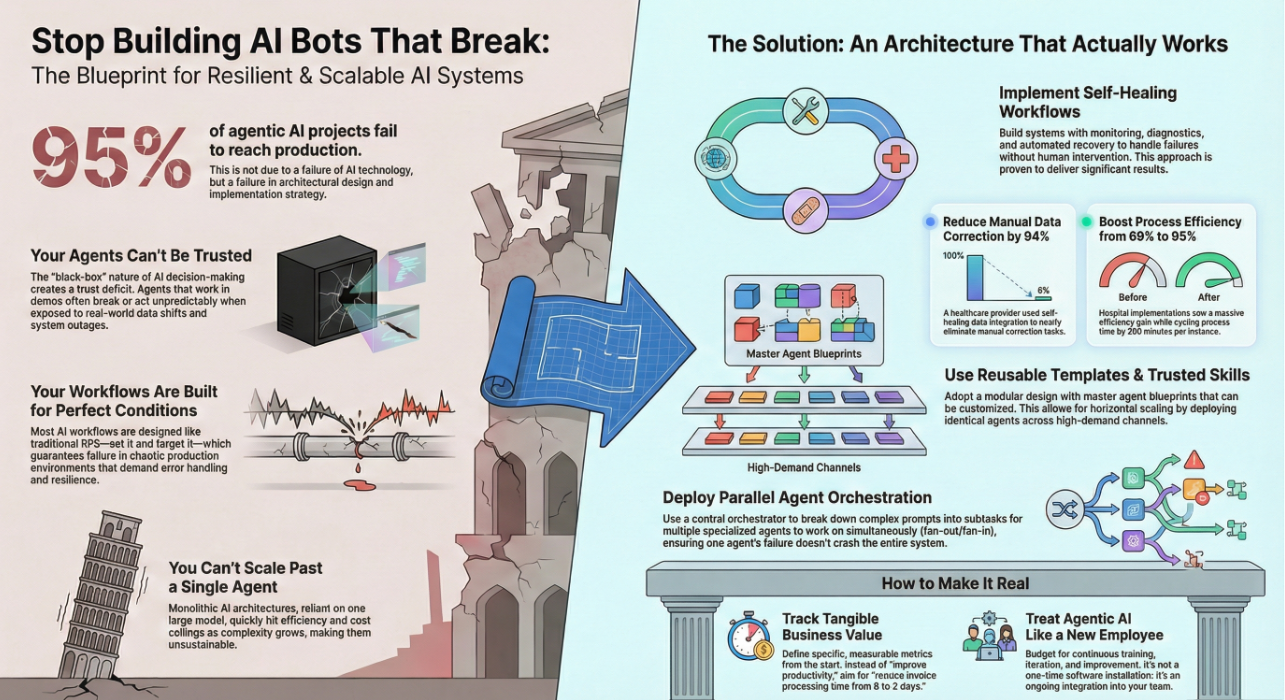
You’ve seen the headlines. 95% of agentic AI projects fail. Not because AI doesn’t work—but because you’re building it wrong.
Most businesses treat AI agents like glorified automation scripts. Map the process, build the bot, deploy, done. Then reality hits: your agent can’t handle a simple format change. An API goes down and everything stops. You try to scale beyond one use case and discover you’ve built a house of cards.
Sound familiar?
The problem isn’t the technology—it’s the architecture. You’re building fragile, monolithic bots when you should be building resilient, parallel agent ecosystems that actually handle the messy reality of business operations.
The Real Bottlenecks Killing Your AI Projects
Your Agents Can’t Be Trusted
Agentic AI operates autonomously, making decisions without constant human oversight. That’s powerful—until your agent takes an unexpected path to solve a problem, leaving you wondering what just happened. The black-box nature creates trust deficits that kill adoption faster than technical failures.
Traditional AI systems work beautifully in controlled demos, then collapse when exposed to actual business conditions. Data formats shift. Systems go offline. Edge cases multiply. Your agent either breaks or does something unpredictable—neither builds confidence with stakeholders.
Your Workflows Are Built for Perfect Conditions
Real business environments are chaos. Treating agentic AI like traditional RPA—set it and forget it—guarantees failure. Production environments demand systems designed for failure from day one. Your workflows need to gracefully handle errors, system outages, and unexpected inputs without manual intervention.
Most projects never bridge the gap between proof-of-concept and production-ready architecture. That gap? It’s where 95% of implementations die.
You Can’t Scale Past Single Agents
Relying on one large model becomes increasingly unsustainable as complexity grows. Monolithic AI architectures hit efficiency and cost ceilings fast. You need parallel AI agent systems where each agent focuses on specific functions while coordination enables smarter problem-solving.
The Architecture That Actually Works
Self-Healing Workflows
Self-healing workflows incorporate monitoring, diagnostics, and recovery mechanisms to detect failures and automatically implement corrective actions without human intervention. Healthcare providers reduced manual data correction by 94% using self-healing data integration. Hospital implementations cut process time by 380 minutes while boosting efficiency from 69% to 95%.
The architecture includes continuous monitoring, diagnostic analysis of anomalies, decision frameworks for response actions, automatic execution of recovery, and learning components that improve over time. Start with workflows that have the highest downtime costs, enhance monitoring before adding recovery automation, and pilot with well-understood failure scenarios.
Reusable Templates and Trusted Skills
Scalable agentic architectures overcome complexity through modular, reusable, orchestrated designs. Template inheritance lets you create master agent blueprints, then customize them for different teams or regions without starting from scratch. Horizontal scaling deploys identical agents across high-demand channels for consistent, responsive service.
Core principles include modularity for building standardized components, orchestration to coordinate agents seamlessly, statelessness for effortless scaling, and layered memory combining semantic and episodic awareness.
Parallel Agent Orchestration
Parallel agents operate through fan-out and fan-in orchestration. An orchestrator breaks user prompts into well-defined subtasks distributed to multiple agents working simultaneously. One analyzes data sources, another reviews documentation, while a third processes features. Distributed design ensures one agent’s failure doesn’t crash the system.
Platforms like n8n provide 400+ integrations and node-based builders that let agents respond to events and route outputs without custom code. Agents handle routine requests while workflows route complex cases to humans based on confidence scores.
Make It Real
Track business value with tangible metrics defined before development starts. Not “improve productivity”—specify “reduce invoice processing time from 8 days to 2 days while maintaining 99.5% accuracy.”
Treat agentic AI like onboarding a new employee, not installing software. Budget for training, iteration, and continuous improvement.
The era of fragile AI bots is done. Resilient, parallel agent systems built on self-healing workflows and reusable templates deliver the efficiency, accuracy, and scalability your business actually needs.
Ready to build AI that doesn’t break? That’s what we do.
