
Google Antigravity is Here: Stop Coding, Start Orchestrating
The game has changed.
We aren’t just talking about “smarter” autocomplete anymore. With the release of Google Antigravity in late 2025, the industry didn’t just shift—it flipped. We have moved from writing code to orchestrating agents.
If you are still treating your IDE like a text editor, you are working too hard. Antigravity is an “agent-first” environment built on a heavily modified fork of VS Code, powered by the Gemini 3 model family. Its job? To take complex, multi-step engineering tasks off your plate so you can focus on the architecture.
But here is the catch: Your agent is only as smart as the “Skills” you feed it.
In this breakdown, I am going to walk you through the architecture of this new beast and, more importantly, the exact GitHub repositories you need to turn a generic AI into a domain-expert engineer.
The Anatomy of a Skill
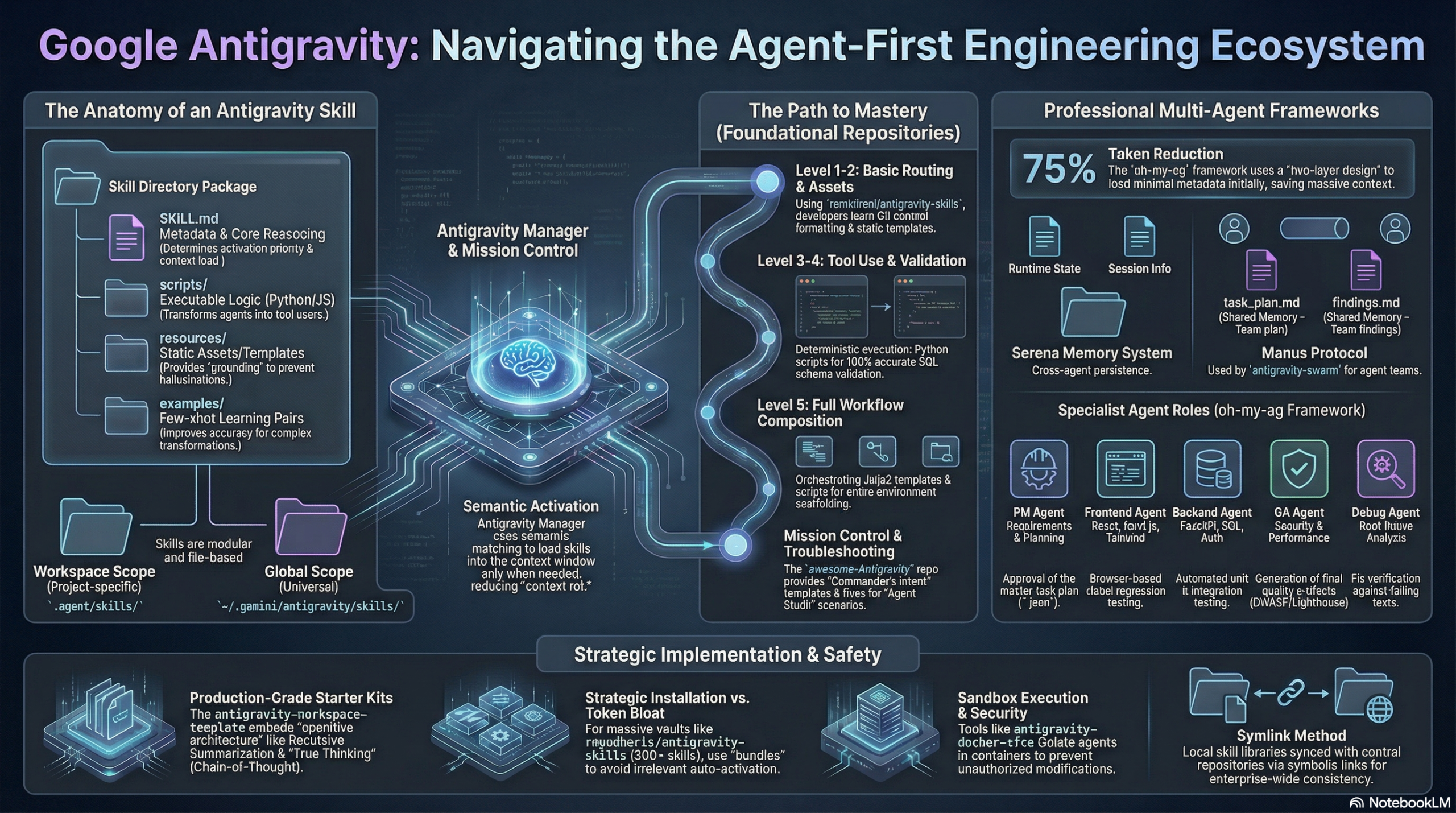
Forget static prompts. In Antigravity, a “Skill” is a modular, on-demand extension that gets loaded into your agent’s context window only when it’s actually needed. This solves “context rot”—keeping the LLM focused and fast.
A Skill isn’t just a file; it’s a package. Here is the directory structure you need to know:
SKILL.md: The brain. This mandatory file tells the orchestrator what this skill does and when to use it.scripts/: The hands. Executable scripts (Python, Bash, Node) that let the agent actually do things, not just talk about them.resources/: The knowledge. Static templates and legal text to prevent hallucinations.examples/: The training. Few-shot learning pairs to show the agent exactly what you want.
When you type a prompt, the Antigravity Manager scans your SKILL.md files (either in your project root or your global user scope) and activates the right tools for the job.
The “Must-Have” Repositories for 2026
You don’t need to build everything from scratch. The open-source community is already lightyears ahead. Here is your curated list of repositories to download right now.
1. The Bootcamp: rominirani/antigravity-skills
If you are new to the “Agentic Command Line,” start here. This repo is the industry standard for learning skill architecture.
It takes you through 5 levels of complexity:
- Basic Routing: Teach an agent to format Git commits automatically.
- Asset Utilization: Use the
resources/folder to insert license headers perfectly every time. - Deterministic Execution: The holy grail. Level 4 shows you how to use a
database-schema-validatorskill that runs a Python script to check your SQL. This ensures 100% accuracy, offloading the logic from the LLM’s “maybe” to a script’s “definitely.”
2. The Professional Framework: first-fluke/oh-my-ag
Ready to scale? This is for the pros. The oh-my-ag framework gives you a full suite of specialized agents: PM, Backend, Frontend, QA, and Debug.
The killer feature here is the “Serena Memory” system. It dumps runtime state into markdown files in .serena/memories/, creating a persistent brain for your project. Plus, it uses a “two-layer design” that slashes token usage by 75%, meaning you can have longer, more complex sessions without hitting the wall.
3. The Swarm: wjgoarxiv/antigravity-swarm
Antigravity is great, but sometimes you need a team. This repo fixes a major gap: it lets your Main Agent “hire” sub-agents (Architects, Engineers, Validators) to work in parallel.
It uses the “Manus Protocol”—a set of shared markdown files (task_plan.md, progress.md) that act as a whiteboard for your swarm. Crucially, it enforces a “Quality Validator” agent that must sign off on work before the mission is marked complete. No more hallucinations making it to production.
4. The Vault: rmyndharis/antigravity-skills
This is the massive warehouse. It contains over 300 specialized packages, porting the extensive Claude Code ecosystem directly into Antigravity.
Warning: Do NOT install the whole thing. You will bloat your tokens and confuse your agent. Use the catalog.json to perform a “Strategic Installation” of only the bundles you need—like Kubernetes ops, React development, or Security auditing.
Don’t Start Empty: The Workspace Template
Stop creating empty folders. Use study8677/antigravity-workspace-template.
This repo pre-loads a “cognitive architecture” into your project using .cursorrules. It forces the Gemini 3 model into “Deep Think” mode, requiring a Chain-of-Thought step before it touches a single file. It turns your IDE from a passive tool into an active partner that understands your architecture from the very first prompt.
The Bottom Line
Antigravity isn’t just an upgrade; it is a new way of working.
- Learn the basics with
rominirani. - Start your projects with
study8677. - Scale your team with
first-flukeandwjgoarxiv.
The future of software isn’t writing code—it’s managing the agents that write it for you. Get your skills installed, set up your workspace, and let’s get to work.